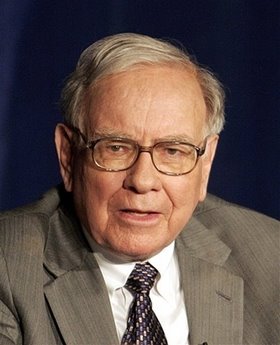
 “Charlie Munger was right when he said that the top 25 managers at Berkshire could all die at once and Berkshire would continue successfully. Berkshire by its very culture and structure is deeper than any other conglomerate because it doesn't exist with just one CEO. Berkshire is a holding company of CEOs all operating independently of one another. Unlike every other traditional corporation, none of the CEOs has a term limit. All the Buffett CEOs have designated a successor.”
Monday, September 25, 2006
The Warren Buffett CEO 9: Interview with an author, Robert P. Miles III
“Charlie Munger was right when he said that the top 25 managers at Berkshire could all die at once and Berkshire would continue successfully. Berkshire by its very culture and structure is deeper than any other conglomerate because it doesn't exist with just one CEO. Berkshire is a holding company of CEOs all operating independently of one another. Unlike every other traditional corporation, none of the CEOs has a term limit. All the Buffett CEOs have designated a successor.”


Saturday, September 23, 2006
The Warren Buffett CEO 8: Interview with an author, Robert P. Miles II
 “Since Warren Buffett has never lost a CEO to another competing enterprise, all the managers reported complete satisfaction with their deal and ongoing relationship.”
 “Warren asked that no interview transcripts be sent to him because he didn't want to influence the book in any way. No one asked for manuscript approval and no one asked for any changes in the book.”
Friday, September 22, 2006
The Warren Buffett CEO 7: Interview with an author, Robert P. Miles I
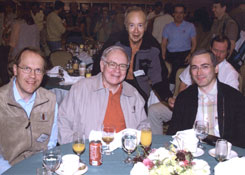
Excerpts from an interview with Robert P. Miles:
“It's totally up to each manager. Few meet with him in person. Most phone every few weeks if they need advice or want to report in. After the purchase of See's Candies, it was over 20 years before its CEO, Chuck Huggins, even visited Omaha.”
“….Bill Child of R.C. Willey Home Furnishings took a call from a dissatisfied customer right in the middle of our interview. He also lists his home phone on his business card. The Tatelman brothers of Jordan Furniture treat their employees like they are the customers. Executive Jet CEO Rich Santulli keeps his small corporate office near New York City while most of his employees and his operational center are in Columbus.”
Thursday, September 21, 2006
The Warren Buffett CEO 6: Al Ueltschi

 “Before we became part of Berkshire, when we were on the New York Stock Exchange, I was constantly questioned about how much money we were going to make the next quarter and why we didn’t make more the last quarter. Now we run the company for the long term without worrying about the next quarter. That’s one of the best things about working with Warren.”
 “Leadership is really what being a good manager is about, and the letters of the word represent the qualities that a good manager should have:
L – Loyalty
E – Enthusiasm
A – Attitude
D – Discipline
E – Example, a good Example
R – Respect
S – Scholarliness
H – Honesty
I – Integrity
P – Pride”

“Aim to be the leader in your field. Strive to be the benchmark against which your competitors measure their progress.”
Note: Ueltschi (pronounced Yule - chee)
Tuesday, September 19, 2006

Monday, September 18, 2006
The Warren Buffett CEO 4: Ajit Jain

“When you take risks, you have to accept that you have some losses. You can’t let this keep you at night. When we make a deal, we stick to it.”
“Avoid dumb mistake—do everything possible to anticipate the risks in a deal. The worst thing is when something you hadn’t even considered comes back to haunt you.”
“A good manager must quickly make a decision and move on. If you’re on the fence about a particular deal, then you probably should decline and move on to the next opportunity.”
Sunday, September 17, 2006
The Warren Buffett CEO 3: Lou Simpson
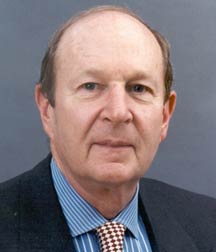 5 basic principles for stock portfolio:
1) Think independently. “We try to be skeptical of conventional wisdom, and try to avoid the waves of irrational behavior and emotion that periodically engulf Wall Street.”
2) Invest in high-return businesses that are run for the shareholders. “Cash flow, which is more difficult to manipulate than reported earnings, is a useful additional yardstick.”
3) Pay only a reasonable price, even for an excellent business. “Even the world’s greatest business is not a good investment, if the price is too high.”
4) Invest for the long term. “Moving in and out of stocks frequently has two major disadvantages that will substantially diminish results: transaction costs and taxes. Capital will grow more rapidly if earnings compound with as few interruptions for commissions and tax bites as possible.”
5) Do not diversify excessively. “The more diversification, the more performance is likely to be average, at best.”
Saturday, September 16, 2006
The Warren Buffett CEO 2: Tony Nicely
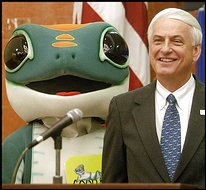 “We don’t want only to be the fairest organization that we could possibly be; we also want to be perceived as the fairest organization possible. I think that’s an even higher standard.”
 “Honesty and integrity have to be set at the top of the list. But it not only has to be there, there has to be a perception that it’s there.”
Friday, September 15, 2006
The Warren Buffett CEO 1
 “Management changes like marital changes, are painful, time-consuming and chancy.”
 “Contract cannot guarantee your continued interest; we would simply rely on your word.”
“We want our managers to think about what counts, not how it will be counted.”
Thursday, September 14, 2006
Charlie Munger in Damn Right! 9
“It’s….necessary to accommodate a lot of failure, and because no matter how able you are, you’re going to have headwinds and troubles. The Sees who created this business had failed at least once, and had seriously failed. But if person just keeps going on the theory that the life is full of vicissitudes and just does the right thinking and follows the right values it should work out well in the end. So I would say, don’t be discouraged by a few reverses”

“One of Bernard Shaw’s characters explained professional defects as follow: ‘In the last analysis, every profession is a conspiracy against the laity.’”
“To a man with only a hammer, every problem tends to look pretty much like a nail.”

“One of Bernard Shaw’s characters explained professional defects as follow: ‘In the last analysis, every profession is a conspiracy against the laity.’”
“To a man with only a hammer, every problem tends to look pretty much like a nail.”
Wednesday, September 13, 2006
Charlie Munger in Damn Right! 8
“First rate man should be willing to take at least some difficult jobs with a high chance of failure.”

“I’ve been in one aspect or another of investment management for what. 44 years or so, and trying not to disappoint anyone,” said Buffett. “And in the process of not disappointing anyone, one of the key factors is having them have the proper expectations and being knowledgeable about what they’re getting and what they’re not getting. Neither Mr. Munger nor I would function as effectively if we had tens of thousands of people who were in one way or another disappointed with us. That’s not Berkshire.”
“I’ve been in one aspect or another of investment management for what. 44 years or so, and trying not to disappoint anyone,” said Buffett. “And in the process of not disappointing anyone, one of the key factors is having them have the proper expectations and being knowledgeable about what they’re getting and what they’re not getting. Neither Mr. Munger nor I would function as effectively if we had tens of thousands of people who were in one way or another disappointed with us. That’s not Berkshire.”
Tuesday, September 12, 2006
Charlie Munger in Damn Right! 7
“You want in a group of people someone who points out that the emperor has no clothes.”

“Smart, hard-working people aren’t exempted from professional disasters of overconfidence. Often, they just go aground in the more difficult voyages they choose, relying on their self-appraisal that they have superior talents and methods.”

“Smart, hard-working people aren’t exempted from professional disasters of overconfidence. Often, they just go aground in the more difficult voyages they choose, relying on their self-appraisal that they have superior talents and methods.”
Monday, September 11, 2006
Charlie Munger in Damn Right! 6
 “Charlie says as you get older you tolerate more and more in your old friends and less and less in your new friends.” – Warren Buffett
 Warren Buffett scolded investment bankers for providing whatever advice would bring them the most income: “Don’t ask you barber whether you need a haircut,” he wrote in Berkshire’s 1982 annual report.
Sunday, September 10, 2006
Charlie Munger in Damn Right! 5

“The game of investing is one of making better predictions about the future than other people. How are you going to do that? One way is to limit your tries to areas of competence. If you try to predict the future of everything, you attempt too much. You’re going to fail through lack of specialization.”
“We’re willing to forego short-term results for long-term gains.”
Saturday, September 09, 2006
Charlie Munger in Damn Right! 4
“We have gotten by trying to be consistently not stupid, instead of trying to be very intelligent. There must be some wisdom in the folk saying, ‘It’s the strong swimmers who drown.’”
“You start with the accounting figures. But that’s only the start. If you try and make judgments just based on accounting figures, you will make one terrible error after another. We’ve got to understand the accounting and the implications of the accounting and understand it thoroughly and also ask a lot of intelligent questions to enable us to judge what is really going on.”
Friday, September 08, 2006
Charlie Munger in Damn Right! 3

“If you mix raisins with turds, they are still turds.”
“Being prepared, on a few occasions in a lifetime, to act promptly in scale, in doing some simple and logical things, will often dramatically improve the financial results of the lifetime. A few major opportunities clearly recognizable as such, will usually come to one who continuously searches and waits, with a curious mind, loving diagnosis involving multiple variables. And then all that required is a willingness to bet heavily when the odds are extremely favorable, using resources available as a result of prudence and patience in the past.”

Thursday, September 07, 2006
Charlie Munger in Damn Right! 2
 “The best way to avoid envy is to deserve the success you get.”
 “The investment game always involves considering both quality and price, and the trick is to get more quality than you pay for the price. It’s just that simple.”
“Never wrestle with a pig because if you do you’ll both get dirty, but the pig will enjoy it.”
Wednesday, September 06, 2006
Charlie Munger in Damn Right! 1
“To finish first you have to first finish.”
“The rabbit runs faster than the fox, because the rabbit is running for his life while the fox is only running for his dinner.” – Richard Dawkins, “The Selfish Gene”
“You have to learn to be a follower before you become a leader. People should learn to play all roles.”

Tuesday, September 05, 2006
Peter Lynch on Beating the Street 12

“Sell a stock because the company’s fundamentals deteriorating, not because the sky is falling.”
“Nobody can predict interest rates, the future direction of the economy, or the stock market. Dismiss all such forecasts and concentrate on what’s actually happening to the companies in which you’ve invested.”
“If you don’t study any companies, you have the same success buying stocks as you do in a poker game if you bet without looking at your cards.”
Monday, September 04, 2006
Peter Lynch on Beating the Street 11
 “Behind every stock is a company. Find out what it’s doing.”
“Owning stocks is like having children—don’t get involved with more than you can handle.”
“Never invest in a company without understanding its finances.”
“Everyone has the brainpower to make money in stocks. Not everyone has the stomach. If you are susceptible to selling everything in a panic, you ought to avoid stocks and stock mutual funds altogether.”
Sunday, September 03, 2006
Peter Lynch on Beating the Street 10

“Investing is fun, exciting, and dangerous if you don’t do any work.”
“Your investor’s edge is not something you get from Wall Street experts. It’s something you already have. You can outperform the experts if you use your edge by investing in companies or industries you already understand.”
“Over the past three decades, the stock market has come to be dominated by a herd of professional investors. Contrary to popular belief, this makes it easier for the amateur investor. You can beat the market by ignoring the herd.”

Saturday, September 02, 2006
Peter Lynch on Beating the Street 9

“Corporations, like people, change their names for one of two reasons: either they’ve gotten married, or they’ve been involved in some fiasco that they hope the public will forget.”
“During periods when mutual funds are popular, investing in the companies that sell the funds is likely to be more rewarding than investing in their products. I’m reminded that in the Gold Rush the people who sold picks and shovels did better than the prospectors.”
“As the price of the stock rose, the Wall Street analysts increased their earnings estimates for the company. This is an example of tailoring the means to fit the ends.”
Friday, September 01, 2006
Peter Lynch on Beating the Street 8

“A sneaky method by which unscrupulous banks and S&L camouflage their problem loans. If a developer, say, asks to borrow $1 million for a commercial project, the bank offers him $1.2 million on the basis of an inflated appraisal. The extra $ 200,000 is held in reserve by the bank. If the developer defaults on the loan, the bank can use this extra money to cover the developer’s payments. That way, what has turned into a bad loan can still carried on the books as a good loan—at least temporarily……. If it’s right, it’s another reason to avoid investing in banks and S&Ls with large portfolios of commercial real estate.”
“Corporate managers often pay lip service to “enhancing shareholder value” and then go out and squander the money on fanciful acquisitions, ignoring the simplest and most direct way to reward shareholders—buying back shares.”

Thursday, August 31, 2006
Peter Lynch on Beating the Street 7

“The best stock to buy may be the one you already own.”
“There’s no shame in losing money on a stock. Everybody does it. What is shameful is to hold on to a stock, or, worse, to buy more of it, when the fundamentals are deteriorating.”
“Stockpicking is both an art and science, but too much of either is a dangerous thing. A person infatuated with measurement, who has his head stuck in the sand of the balance sheets, is not likely to succeed. If you could tell the future from a balance sheet, then mathematicians and accountants would be the richest people in the world by now.”
Wednesday, August 30, 2006
Peter Lynch on Beating the Street 6

“The newspaper had made a big deal of this “worst one-day drop since 1929,” even though the comparison was absurd. A 36-point drop with the Dow at 990 was not the same thing as a 36-point drop with the Dow at 280, which is where it stood before the Crash.”
“In stocks as in romance, ease of divorce is not a sound basis for commitment. If you’ve chosen wisely to begin with, you won’t want a divorce. And if you haven’t, you are in a mess no matter what. All the liquidity in the world isn’t going to save you from pain, suffering, and probably a loss of money.”
Monday, August 28, 2006
Peter Lynch on Beating the Street 5

“The extravagance of any corporate office is directly proportional to management’s reluctance to reward the shareholders.”
“Pulling out the flowers and watering the weeds.”
“This is one of the keys to successful investing: focus on the companies, not on the stocks.”
Sunday, August 27, 2006
Peter Lynch on Beating the Street 4
“Japanese investors, we hear, paid little heed to earnings and focused their attention to cash flow – perhaps due to shortage of the former. Companies spend money like drunken sailors, especially on acquisitions and real estate, are left with a huge depreciation allowance and a lot of debts to pay off, which gives them a high cash flow/low earnings profile.”
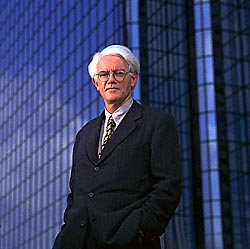
“Japanese banks were making 100% loans on zero collateral for office buildings where in the most optimistic scenario the rents would barely cover the expenses.”

“Japanese banks were making 100% loans on zero collateral for office buildings where in the most optimistic scenario the rents would barely cover the expenses.”
Friday, August 25, 2006
Peter Lynch on Beating the Street 3
 “It isn’t the head but the stomach that determines the fate of the stockpicker.”
“Good information is useless without the willpower. In dieting and in stocks, it is the gut and not the head that determine the results.”
“Keeping the faith and stockpicking are normally not discussed in the same paragraph, but success in the latter depends on the former. You can be the world’s greatest expert on balance sheet or p/e ratios, but without faith, you’ll tend to believe the negative headlines.”
Peter Lynch on Beating the Street 2

“Just because a stock goes down doesn’t mean it can’t go lower.”
“You should not buy a stock because it’s cheap but because you know a lot about it.”
Wednesday, August 23, 2006
Peter Lynch on Beating the Street 1
 “There’s a Tolstoy story that involves an ambitious farmer. A genie of some sort offers him all the land that he can encircle on foot in a day. After running at full speed for several hours, he acquires several square miles of valuable property, more soil than he could till in a lifetime, more enough to make him and his family rich for generations. The poor fellow is drenched with sweat and gasping for breath. He thinks about stopping—for what’s the point of going any further?—but he can’t help himself. He races ahead to maximize his opportunity, until finally he drops dead of exhaustion. This was the ending I hoped to avoid.”
Wednesday, August 16, 2006
Low Risk, Low Return; High Risk, High Return?
 People often say: “Low risk, low return; high risk, high return.” Is it a truth? Let’s us examine it through an example of the investments made shown below.
Fund CAT is the best performer in Malaysian Unit Trust (Mutual Fund) industry for the period of more than 5 years as per 23rd June 2006. In the stable of around 400 funds to choose from, whether it is equity fund, bond fund, mixed fund, money market fund and so forth, it is the fund that gives the best return to its unit holders.
Fund CAT performance from 25th June 2001 to 23rd June 2006 is 113.04% which translated into 16.33% Compounded Annual Growth Rate (CAGR). One should notice that 2001/02 was the most bargain market since 1999. When count from an inception date of Fund CAT, which is in 1999, the fund performance is 90.5%, which translated into 9.67% CAGR.
How about placing all investment in a single stock? Is it really a high risk investment? Take an example of RLQ. RLQ is a resource-based company and its core activities are in 3 categories, namely Marine Products Manufacturing (MPM), Crude Palm Oil Milling (CPOM) and Integrated Livestock Farming.
 In the same period, RLQ generates a return of 119.27%, which is 17% CAGR. Bear in mind that RLQ is not the best performer of the market. Furthermore, since RLQ main businesses are in resource-based industry, any negative happenings would have impact to its performance. In the period mentioned, RLQ experienced few incidences such as high price of raw materials such as soy bean meal and corn meal, 2 bird flu threats and tsunami which have a huge negative impact to its underlying businesses. Nevertheless, it gives a better performance compared to Fund CAT which adapts a diversification policy.
While at a glance, Fund CAT is a more low risk investment made since its investments are well diversified into various sectors, money market and cash. At the same time, investment made on RLQ seems pose a high risk to its investors since RLQ businesses are in resource based industry, meaning that any negative happenings in the industry would cause negative impact to RLQ bottom line and ultimately to its investors. Nevertheless, anyone who chooses either Fund CAT or RLQ as his investment would reap similar return to his nest egg. One should always remember that investment made through rear mirror would not guarantee his investment success. When an investment result is most of the time relied on capability of the investment manager, it is worthwhile to aware any changes in fund’s investment team members. They are the one who decide the investment result of yours.
Note: As we are investors with long term perspective, any investment with less than 5 years is meaningless. Thus, we only use investments with minimum 5 years period for comparison. Remember, investment is a marathon, not a 100 meter race.
Monday, August 14, 2006
Saturday, August 12, 2006
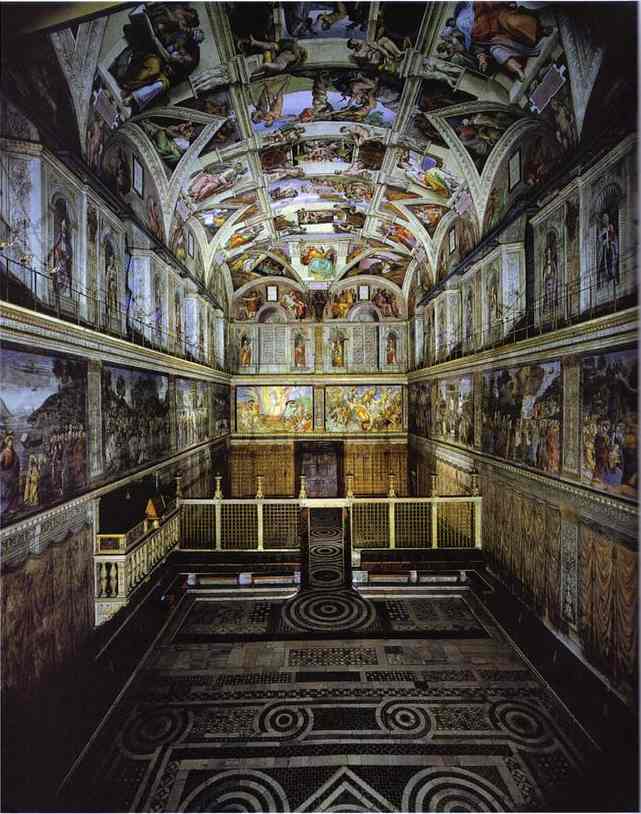
Oasis of Eternity -- Michelangelo 6: The Dome of Saint Peter's Basilica

Michelangelo, who often called as “Il Divino” (The Divine One) in his life time designed and became a chief architect the dome (cupola) of Saint Peter’s Basilica, Vatican City, Rome in 1546. After his death, the work continued by Giacomo della Porta with the assistance of Domenico Fontana.
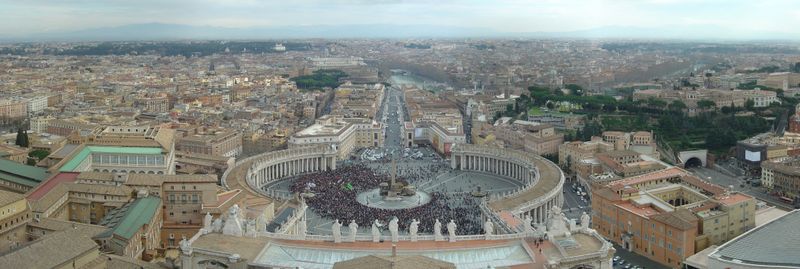
The dome has a diameter of 42 meter and it is the largest dome in the world. It is reaching 138 meter high. The site is the buried site of Saint Peter, one of the apostle of Jesus Christ in 64 A.D.
Wednesday, August 09, 2006
Invest for Long Term??
Excerpts from: http://www.theedgedaily.com/
 “The Malaysian equity funds have posted "respectable returns" over the mid- to long-term periods, the Federation of Malaysian Unit Trust Managers (FMUTM). It said based on Standard & Poor's report on the fund performance as at July 28, 2006, the average returns for Malaysian equity funds for the seven-year period was 24%, five-year period 56% and three-year period 26%.”
Period (year) 3 5 7
UT Return (%) 26 56 24
UT CAGR (%) 8.01 9.30 3.12
FD Return with 4% CAGR (%) 12.49 21.67 31.59
As we can notice from the table above, by placing your money in unit trust (mutual fund) investment for 3 years, the return for the period would be 26% and when it translates to Compounded Annual Growth Rate (CAGR) which is 8.01. Similarly, for the period of 5 and 7 years, the return is 56% and 24% respectively and for CAGR for both, the former is 9.30% and the later is 3.12%. What will you get if you place your investment in “risk-free” Certificate of Deposit (CD) or known as Fixed Deposit (FD) in English Commonwealth countries? With 4% return annually, the figure will shock us!! For the period of 7 years, this “risk-free” investment performs better than unit trust (mutual fund) investment with more than 7%. When handling your hard-earned monies on hoping for better value creation by those fund managers, it seems that they do not fulfill your hope and as they promise – create value to its investors.
While the promoters of the unit trust investment always brainwash us “look for long term”, “let professionals handle your investment” and so forth, the reality is so cruel – it creates no value at all to the investors for longer term. When the promoters once again claim for the “outstanding” performance for 5 years period, bear in mind that the period is started from the 2001/02 market where it was the lowest. The best fund manager is not who gets the highest return when it is bull market, it is who gets the best result when it is bear market. It reminds me once again a famous quote by Warren Buffett: “It’s when the tide down, only you know who is swimming naked.”
 “The Malaysian equity funds have posted "respectable returns" over the mid- to long-term periods, the Federation of Malaysian Unit Trust Managers (FMUTM). It said based on Standard & Poor's report on the fund performance as at July 28, 2006, the average returns for Malaysian equity funds for the seven-year period was 24%, five-year period 56% and three-year period 26%.”
Period (year) 3 5 7
UT Return (%) 26 56 24
UT CAGR (%) 8.01 9.30 3.12
FD Return with 4% CAGR (%) 12.49 21.67 31.59
As we can notice from the table above, by placing your money in unit trust (mutual fund) investment for 3 years, the return for the period would be 26% and when it translates to Compounded Annual Growth Rate (CAGR) which is 8.01. Similarly, for the period of 5 and 7 years, the return is 56% and 24% respectively and for CAGR for both, the former is 9.30% and the later is 3.12%. What will you get if you place your investment in “risk-free” Certificate of Deposit (CD) or known as Fixed Deposit (FD) in English Commonwealth countries? With 4% return annually, the figure will shock us!! For the period of 7 years, this “risk-free” investment performs better than unit trust (mutual fund) investment with more than 7%. When handling your hard-earned monies on hoping for better value creation by those fund managers, it seems that they do not fulfill your hope and as they promise – create value to its investors.
While the promoters of the unit trust investment always brainwash us “look for long term”, “let professionals handle your investment” and so forth, the reality is so cruel – it creates no value at all to the investors for longer term. When the promoters once again claim for the “outstanding” performance for 5 years period, bear in mind that the period is started from the 2001/02 market where it was the lowest. The best fund manager is not who gets the highest return when it is bull market, it is who gets the best result when it is bear market. It reminds me once again a famous quote by Warren Buffett: “It’s when the tide down, only you know who is swimming naked.”
Monday, August 07, 2006
Oasis of Eternity -- Michelangelo 5: David
 David, is one of the two masterpiece sculptured by Michelangelo from 1501 to 1504. The marble statue is 17 ft height. It originally placed in front of the Palazzo Vecchio, Florence but later on moved to Accademia Gallery, Florence in 1873 to protect it from damage.
The statue portrays the Biblical King David before he battles with Goliath. It represents a spirit of Florentine Republic, an independent city state threaten by more powerful rival states. To the citizen of Firenze (Florence), David was a symbol of fortezza and ira, strength and anger. It is a cunning victor over superior enemies. Unlike previous Davids, who shown after victory against Goliath, David by Michelangelo shows his determination and courage to fight against a more superior enemy.
There are two replica of David in Firenze, one in front of the old city hall, and one on a hill overlooking the city.
Saturday, August 05, 2006
Oasis of Eternity -- Michelangelo 4: The Pieta
 The Pieta, which many regard as the greatest sculpture ever made is located in Saint Peter’s Basilica, Vatican City, Rome. It is created by Michelangelo from 1498 to 1500. The marble sculpture was finished before he turned to 25. The art marble depicts the body of Jesus in the arms of his mother Mary after the Crucifixion.
Giorgio Vasari, Italian painter and architect in his “Lives of the Artists” published in 1550, comment: "It would be impossible for any craftsman or sculptor no matter how brilliant ever to surpass the grace or design of this work, or try to cut and polish the marble with the skill that Michelangelo displayed. For the Pieta was a revelation of all the potentialities and force of the art of sculpture. Among the many beautiful features (including the inspired draperies) this is notably demonstrated by the body of Christ itself. It would be impossible to find a body showing greater mastery of art and possessing more beautiful members, or a nude with more detail in the muscles, veins, and nerves stretched over their framework of bones, or a more deathly corpse. The lovely expression of the head, the harmony in the joints and attachments of the arms, legs, and trunk, and the fine tracery of the veins are all so wonderful that it is hard to believe that the hand of an artist could have executed this inspired and admirable work so perfectly and in so short a time. It is certainly a miracle that a formless block of stone could ever have been reduced to a perfection that nature is scarcely able to create in the flesh."
Tuesday, August 01, 2006
Capital Guaranteed Fund III
 Previous posts on Capital Guaranteed Fund:
Capital Guaranteed Fund I
Capital Guaranteed Fund II
Everybody aware of inflation. Due to this animal, $100 we have after a year (FUTURE VALUE) will not allowed you to purchase a same amount product which is quoted in today price (PRESENT VALUE). Giving 5% inflation rate per annum, your $100 of FUTURE VALUE (after a year) will only allowed you buy a product which is quoted today at $86.38 (PRESENT VALUE). Thus, after a 3 years maturity period, RM 300 million of FUTURE VALUE is equivalent to RM 259.15 million of PRESENT VALUE!! With capital guaranteed capped at RM 300 million (FUTURE VALUE) after 3 years, it’s for sure fund could deliver their capital guaranteed even their investment result is poor. They are left with RM 13.21 million (RM 272.36 million – RM 259.15 million) to play around even their investment result delivered no result at all for the entire 3 years period! That’s a “SURE CAPITAL GUARANTEED, ZERO RISK” Investment!!
The calculation above is simplified to an illustration purpose. The assumption made is there is no return (0%) for entire 3 years period.

When fund tagged with “Capital Guaranteed”, it should at least preserve its fund holders’ value. This means that for RM 300 million (PRESENT VALUE), it should at least appreciate to RM 347.29 million (FUTURE VALUE) to align with its tag of “Capital Guaranteed”. If RM 300 million (PRESENT VALUE) remain as RM 300 million (FUTURE VALUE), it actually deteriorates its fund holders’ value at the rate of 5% per annum! What’s the point for investors to invest into these funds if it serves no purpose at all. After all, they could place their money into bank’s Certificate of Deposit (CD) or Fixed Deposit (FD) to enjoy “Capital Guaranteed, Zero Risk” return. Currently, a FD depositor in Malaysia enjoys 3.7% return per annum. So, with RM 300 million (PRESENT VALUE), his account balance will show RM 334.55 million (FUTURE VALUE) after 3 years. That’s almost 35% difference!
What You See Is What You Get? III

As you notice, the difference of BP-BP and ROI decreases when the investment period is longer. From the table, you will shock to notice that you actually incur loss of 5.28% if you cash out after a year of investment. That means if you invest $ 10,000 at the beginning and cash out after a year, you only manage to get back $ 9,472!!
How about the return for Certificate of Deposit (CD) or known as Fixed Deposit (FD) in some countries? Assuming CD/FD could give you 4% return per annum, the return over 5 years period would be:
Year 4% return per annum ROI (%)
0 1 0
1 1.04 4
2 1.0816 8.16
3 1.1249 12.49
4 1.1699 16.99
5 1.2167 21.67

When you compare ROI of Fund KSA and CD/FD, you will notice that ROI of Fund KSA only outpaces CD/FD after 4th year!! Amazing, isn’t it? When you pay hoping for get the better return as compared to “risk-free” CD/FD investment, the outcome is shocking. That is no wonder, the promoters always ask you to invest for long term – the longer the better. We do agree that investment should always for long term (more than 7 years). But, this only applies to the investment that creates value to its investors. If you choose a lousy investment, the longer you hold, the worse you get. Time is unemotional, it would not sympathize you because you choose a lousy investment. In fact, time would punish you if you choose a lousy investment. Time only reward to those who choose a good investment, this is the core of the value investment.
Next time, when the promoters of Mutual Fund (Unit Trust) try to persuade you to purchase the fund and show you how good the return, you should ask them one question: the return is on whose perspective, Fund or investor, that’s you who pull out the money to feed them.
Subscribe to:
Posts (Atom)