Showing posts with label real estate. Show all posts

Tuesday, June 27, 2006

Good Investment IV?


We should bear in mind that the example given is a real case and it is based on most optimistic assumption, meaning that the market price as well as the rental given is in the highest range. Besides, we also omit several transaction costs such as legal fee, valuation fee, management fee, broker fee, maintenance fee, insurance charge, local council assessment fee….etc. We also give the best situation where in the example given, the rental collected is uninterrupted for the whole 360 months. In the real life, we know that it’s impossible to maintain such record. If we consider all those factors, the real net gain will be lesser as shown in the example. Again, the example given is not located in the unfavorable outskirt region. It’s within 10km distance from the city centre, a well developed residential and it’s the landed property where it’s the most sought investment for the real estate investors. With such optimistic assumption and good example given, still it’s only gives mediocre investment result. So, I wonder why so many people still having faith to this type of investment.

An investment should remain to its objective, that’s to create values to the investors, that’s not only safeguard against inflation, but also giving a reasonable good return to the investors. Most often, the investment made is based on sacrifice of the investors’ immediate enjoyment to gain the future pleasure. . If, the investment does not give a reasonable good return, there is no point for the investors’ sacrifice.

Note: We are not against of buying real estate. We are just showing the fact to the people who might still in the “Fortune Dream” because of real estate investment. There are plenty of investments that could bring better return as compared to real estate investment. When talking about investment, think business. Most often, these two can’t be separated.

Real estate posses an emotional value to everyone. After all, everyone needs a home, a lovely home for their families, a place for their families to share the greatest moments. Those moments are the most precious and invaluable, that’s the monies couldn’t buy.
“A House --- $ 270,000.
A Happy Family --- Priceless.”

Sunday, June 25, 2006

Good Investment III?


Before we put into conclusion, let see if we place $ 270,000 in bank’s Certificate of Deposit (CD, in US) or Fixed Deposit (FD, in UK) account which earn 4% per annum, how much will we get after 30 years? $ 875,717.33. At a glance, AP investment seems a good investment, isn’t it? Before we jump into a conclusion, let see what will we get if we invest in say BI investment that earn 15% per annum over 30 years period? The result? $ 1,787,717.84. What if we invest in KB investment that earns 20% per annum over the same period? $ 6,409,160.47!


We often hear the interested parties and the promoters of AP investment urging us to invest in AP. The reasoning given are we can use the power of leverage to maximize our investment, the value of AP is always going up, we only need to lay out the initial payment and the less is borned by our tenants….etc. We also been “brainwashed” decades by decades and we really believe that AP is really a good investment subconsciously. No matter how nice words put on the investment, business is business. At the end, businessman would look at his income statement, balance sheet…etc to determine whether it’s a good investment or not. By showing the example above, it’s obvious that the perception we have is totally out in term of the businessman point of view, that’s creating values to his initial capital investment. Ironically, most people still put their faith into AP investment. Are they ignorant? If one day, the investors realized the truth, will the market crash? The history will tell us the story. “The man who ignores history does not have his story.”

Finally, what’s AP investment? REAL ESTATE.

Thursday, June 22, 2006

Good Investment II?

Result after 30 years in AP investment:

Loan: $ 243,000
Repayment period: 360 months
Interest: 7.5% per annum
Repayment per month: $ 1,699.09
Total payments: $ 611,674.32
Finance charge $ 368,674.32
Principal payment: $ 243,000.00

Finance charge per year: $ 12,289.14
Principal payment per year: $ 8,100.00
Total payment per year: $ 20,389.14

Income per year: $ 9,600 ($800 per month)
1st 7 years total income: $ 67,200
Income per year: $ 10,800 ($900 per month)
Subsequent 7 years: $ 75,600
Income per year: $ 12,000 ($ 1,000 per month)
Another 7 years: $ 84,000
Income per year: $ 13,200 ($ 1,100 per month)
Another 7 years: $ 92,400
Income per year: $ 14,400 ($ 1,200 per month)
Last 2 years: $ 28,800
Total income: $ 348,000
Total Finance charge: ($ 368,674.32)
Loss: ($ 20,674.32)

Equity payment: ($ 270,000)

Sources of income over 30 years in AP investment:
1) Rental: ($ 20,674.32)
2) Capital appreciation: $1,550,742.62 - $ 270,000.00 = $ 1,280,742.62

Net profit: $ 1,260,068.30 – ($ 20,674.32) = $ 1,239,394

How do you derive $1,550,742.62? With principal of $ 270,000 at the beginning of the investment period of 30 years, with 6% per annum return rate, you would get the amount. Why use 6% per annum return rate? The rate is used after considering the real example of the investment over 16 years period which experienced booming and busting period.

In next posting, we will discuss is AP investment match the criteria of “Investment is most successful when it’s most business-like and vice versa.”

Wednesday, June 21, 2006

Good Investment I?

Quote Warren Buffeff: “Investment is most successful when it’s most business-like and vice versa.”

In dealing with business, we need to review the business performance through various financial statements, among others are income statements, balance sheets and cash flow statement. AP is an example of the investment you intend to make. In order to evaluate the feasibility of the investment, let’s examine AP’s financial statements.

First, we go through AP’s income statements after a year of operation. Below are the details:

- Revenue: $ 9,600
- Cost of sales: NA
- Gross profit: $ 9,600
- Interest Expense: ($ 9,720)
- Net profit: ($ 120)


Then, look at the balance sheets:

- Property: $ 270,000
- Current assets: nil
- Current liabilities: nil
- Financed by:-
- Shareholders’ equity: $ 27,000
- Borrowings: $ 243,000


Lastly, we look at the cash flow statements:

- Cash (used in) operation: ($ 480)
- Cash generated from investment: $ 9,600
- Cash (used in) financing: ($ 9,720)
- Net decrease in cash: ($ 600)
- Cash at beginning of year: NA
- Cash at end of year: ($ 600)

We will discuss the feasibility of this investment for the next posting….

Thursday, March 16, 2006

Critical Thinking

Today, an advertisement about real estate investment talk appears in the newspaper. In the ad, the main title is: “Create Wealth with Australian Property. How To Generate 500% Return in 10 Years”. Being curious, I look thoroughly into the ad. The ad gives an example of the return:

- Property Price A$300,000
- Loan Borrowed A$200,000
- Your Investment A$100,000
- Income Return A$ 10,000 per year

10 Years Scenario:
- Price Double A$600,000
- Income Return * 10 Years A$100,000
- Loan Left A$100,000
- Total Return A$500,000

Return of A$500,000 with A$100k Investment = 500%
---------------------------------------------------------------

Wow! Sound great! I could get 500% return in 10 years! Looking around, how many investments could generate such high return rate? But, wait!! There is no free lunch in the world. Thus, read the ad again and think deeply. Hmm…..the scenario becomes clearer.

Firstly, they ask you to place A$100,000 for the investment of A$300,000. That means your gearing is about 33,33%. Fine, that’s the norm for real estate investment where you could even gear up until 100% margin in some cases. Then, they tell you the income return per year is A$10,000, that would translate to 10% return rate per annum (A$10,000 / A$100,000 = 0.1). At this point, everything looks great. But, the real story comes behind:

They are assuming the appreciation will be 100% in 10 years where the price of the house soars from A$300,000 to A$600,000. At the same time, your rental income remains stable for the entire 10 years which gives you A$10,000 * 10 years = A$100,000. This amount would offset against the installment for the loan. Hence, they show you the return of the investment is $600,000 - $100,000 (your initial investment at the beginning) = A$500,000.

When you examine deeply, you will wonder how such return pops up? Firstly, your rental income of A$100,000 could only offset half of the remaining loan (A$200,000), which mean you are still owing bank for another A$100,000. Say, if you sold the house after 10 years, your return would be A$600,000 – (A$100,000 + A$100,000) = A$400,000 where 1st A$100,000 is your initial investment you laid down when you bought the house and the 2nd A$100,000 is the debt you owe to the bank.

You might argue that return of A$400,000 still impressive for 10 years. True, if it’s a case but the example shown miss out some important points. Firstly, they do not include financing costs, ie: legal fee, financing interest, management fee, broker fee, insurance fee….etc. Secondly, the appreciation of 100% within 10 years is solely their assumption. Whether the state could be reach is another consideration. Thirdly, they also assume the rental for the entire 10 years period will never have any empty period, meaning that for the entire 10 years, they guarantee there sure have tenants for your house. In the reality, is it a case? Think it rationally.

With so many questions in doubt, do you think it’s a great investment as claimed by the promoter? THINK IT TWICE….

Technorati Tags: , , , , ,


Tuesday, March 07, 2006

Conventional Wisdom I

There are many conventional wisdoms in the investment world. The wisdoms become urban legend that implanted into most people mind and influence their investment decision either consciously or unconsciously. Let us examine it one by one:

1) Real estate value is always appreciate.

For sure nearly all stuffs in this world appreciate in their pricing. Take a look for the price you pay for a burger sold today and 10 years back. How about the price you pay for a movie ticket? A cup of coffee in café? The only difference is the rate of appreciation. No matter what investment vehicle choice is, the ultimate goal is to beat the inflation rate. If price of burger appreciates 100% in 10 years time and a price of a cup of coffee appreciates same rate, the investment you made must exceed the rate. Otherwise, you are losing – meaning that your purchasing power is lost. While you could buy 100 burgers 10 years back (assuming a burger cost $1 then) with $ 100, today you only manage to buy 50 burgers (assuming a price of burger today is $ 2). If your investment gives you 50% return for the same duration, you are still losing the game. Why? You might ask, after all my $ 100 10 years back become $ 150 today. That’s the trick of the game: inflation gives you an illusion of wealth. Putting same example, a burger cost $ 2 today, how many burgers could you buy with $ 150 in today value? 75, exactly! 75 burgers! That means you lose out 25 burgers if you use the same amount and bought the burgers 10 years back.

Let me show you a real life example. A house bought 15 years ago with price tag $ 110,000. After adding all necessary expenses, let’s assume the cost of the house is $ 120,000. Today, if you decide to sell the house in a secondary market, the buyer will offer you $ 270,000. Wow! Sound good, because I gain $ 150,000 ($ 270,000 - $ 120,000). When you use financial calculator to count for the yield, you would find out it only gives you a mediocre return, with 5.56% yearly compounded return. How much you will get if you invest in another vehicle which gives you 12% annual compounded return for same period? $ 660,000!! Instead gaining $ 150,000, you could reap $ 540,000 ($ 660,000 - $ 120,000). See the difference?

People might argue that besides capital gain, a wonderful part of real estate investment is its rental income. Let’s examine it again with the mentioned example. The monthly rental today is $900. That means over the period of 15 years, the total rental income generated from this investment is $ 162,000 ($ 900 * 12 * 15). Adding the capital gain of $ 150,000 with the total rental income, this means you will get $ 312,000 in total ($ 150,000 + $ 162,000), which translates into 6.58% annual compounded return. Bear in mind, for the sake of simplification, I already assume the rental income in higher end, which is fall in the later part of the period (In reality, the monthly rental is less than $ 900 15 years back). Not to forget is the calculation is based on the assumption that you purchased the house with cash, without financing. If you choose to put 10% down payment, the financing cost and other related costs would eat up most parts of your return, where the financing rate fluctuated around 6.5% to 10% over the period. Do not forget about the taxation effect. Depending on your income bracket, your rental income also constitutes your income tax. By adding this extra cost, your return on your real estate investment would be lower.

The example shown here is a landed residential property and located 10 km from the city centre. The brokers always proclaim: “Location, Location, Location.” as a paramount importance in order to make a good investment, from the example, it seems not.

Do your maths and think it independently, is real estate really a good choice of investment to hedge against inflation? The conventional wisdom might true, might not, depend to the situation. When seeking opinion, choose the right candidate, not the interested parties. Like somebody saying: “Cheated once, shame on you; cheated twice, shame on me.”

Monday, February 27, 2006

Is Real Estate a Good Investment? VI

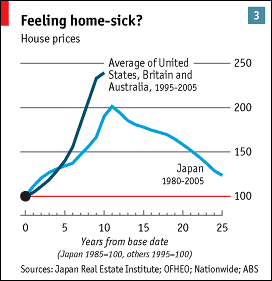
Correction: Years from base date for Japan should be 1980 and not 1985.

From the graph, it showed that house price in Japan soared 100% from 1980 to 1990. After the bubble burst, Japan suffered from a massive economic depression which lasted 15 years until 2005 which we saw there is a sign of economic recovery. Still, house price in Japan does not recover from its peak. In 2005, it signifies the depression of nearly 40%, this means if you bought a house for $ 200,000 in 1990, your house is worth $ 120,000 in 2005. This is a scenario if you bought with hard core cash. How about the one who highly leverage with housing loan? The consequence is more drastic, the real estate that they invested still in a group of “Negative Equity”, meaning that even you sold off the house, you are still in debt and need to repay back the balance to the bank. That’s the impact of leverage, in contrast to the one who always persuade you for the “Power of Leverage”. They are right in one point: Leveraging could shorten your investment return IF the market is booming; when the market burst, you not only lose all your investment but you would be in debt as well.

While in Australia, Britain and US, the average house price since 1995 registered a handsome return of nearly 150%. If you laid the investment since the beginning of 1995 and bought the house which priced $ 100,000, your investment worth almost $ 250,000 in 2005. The return could be higher if you are buying with highly leverage housing loan. While the house price for the past 10 years gave the investor of that time a handsome return, do you think it will do the same for the next 10 years, or it will show the same trend as Japanese backed to 1990? The answer? Only God knows…

“Any indication for you?”

Saturday, February 25, 2006

Is Real Estate a Good Investment? V

There are many reasons that influence the up and down of one product or service, being it equities, commodities, bus fare you pay, lawyer fee…etc. Though, there are so many reasons that could influence the pricing, the 2 most important reasons are Supply and Demand factor and Human Psychology factor.

In every aspect, Supply and Demand factor plays a very important role. It’s a simple thought. Whenever the supply is tight, you need to pay more in order to get the stuffs you need and vice versa. Through this mechanism, it creates equilibrium of the economy.

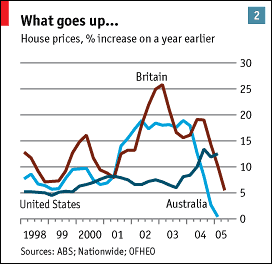
Human psychology factor is a must consideration whenever we make any investment. People tend to think rational when he is alone but when they are in a group, the reverse could happen. The logic is simple: When you are alone, you could filter out all the rubbish thoughts and think it rationally. While in a group, your personal critical and rational thought would be influence by a group thought. Human is a social animal. We need an assurance from others to validate our existence. If your thought is not within a group of same league, you will be treated as a weird person, you will be facing peer pressure. At this moment, being RIGHT IN FACT is no longer your ultimate consideration, but being RIGHT IN THE GROUP is the only consideration at this point.As shown in the graph, we notice that the house enjoyed a handsome appreciation starting the new millennium. This is more prominent in Britain and Australia. For example, Australian real estate enjoyed a double digit growth from 2001 until 2004, which recorded an appreciation of 15%, 18%, 18% and 18% for the period. What is this means? This means when you bought a house for the price of $ 100,000 from 1st January 2001, your investment will appreciate to $ 188,948 at the end of 2004. That is almost double your investment within 4 years! Is average Joe on the street enjoyed their wage increment same pace as in real estate market during that period? How about the rental of this real estate growth rate? Is the growth rate in tandem with the appreciation? If the answer is no, will you think such high growth rate can be sustain? Remember Supply and Demand factor?

It’s always a better way to seed a “picture” into the reader’s mind in order for them to understand the conceptual theories and so forth. Let me give you an example, when a new 42 inch High Definition (HD) TV launched, its price tag is $ 20,000. With some reasons, the TV’s price tag becomes higher and higher and soon the price reaches at $ 40,000 within 3 months. The underlying reasons for the appreciation could be any. It could be: The FIFA World Cup soccer season is approaching, people want to enjoy a high quality picture of those matches and rushing for the TV, the supplier is lack of stock because of the World Cup fever…etc. Sooner or later, people might find out that is it worth to “invest” $ 40,000 for those luxurious? If their mind changing a direction, they will dump their “investment” in a secondary market and at the same time, it will cause pricing pressure for the new HDTV. At this time, from the price of $ 40,000, the price could drop to $ 30,000, $ 20,000, $ 10,000 or even $ 2,000? What’s the result? Is it always an insider and intelligent investors who make fortune out of the insanity and stupidity of the average Joe on the street. From Tulip mania in 17th century to Dot-com bubble in the beginning of new millennium, history already show that human being always repeat same mistake. It’s not because human is not smart, it’s just because human weakness on “Greed and Fear”. For the next boom and bust, how do you position yourself?

Any indication for you?

Wednesday, February 22, 2006

Is Real Estate a Good Investment? IV

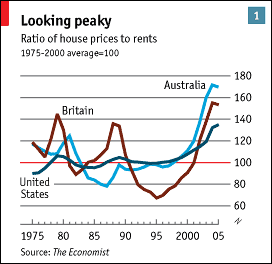
In the businessman point of view, the rate of return is crucial to determine whether he wants to make the investment or not. In the equity market, people use Price Earnings (P/E) ratio as a reference for the investment. Take an example, if P/E of stock ABC is 5, this means he needs 5 years to get back his initial investment and this translates 20% annual return rate. While for stock XYZ where the P/E is 20, this means investors of XYZ company need to wait for 20 years to get back his initial investment and this translate to 5% annual return rate. That's the reason a savvy investors always tell you that, whether you make a good investment is not when you sold it, but when you buy it.

As we can see from the graph where a ratio of house prices to rents (P/R), which is equivalent to equity P/E ratio, the ratio was 100 in between 1975 - 2000. But the trend moved to north exponentially after 2000 when the Dot com bubble burst, this trend more prevail in Australia and Britain. Australia registered a ratio around 170, Britain 155 and US 135 in 2004. What is it means? The ratio of 170 means the price of real estate in Australia in 2004 is either 70% higher if compare to the average price for the period of 1975 - 2000 or the rental is 70% lower for the mentioned period. If you deduct all the related expenses for real estate such as management fee, broker fee, insurance charge and so forth, the ratio could be higher.

While people could argue that we could not compare real estate investment with equities because real estate is "REAL", it is not a paper value. True, real estate is "Real" in physical but the illusion of control could harm the judgment of the investors. For every investment decision made, we could not run from the reality of the rate of return, no matter it is in equities, bond, real estate, commodities market...etc.

Any indication for you?

Is Real Estate a Good Investment? III

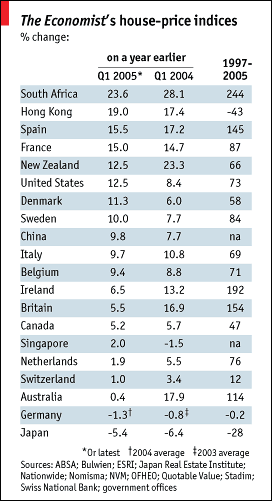
Source: The Economist publication dated 16th June 2005


Any indication for you?


Is Real Estate a Good Investment? II

Source: The Economist publication dated 16th June 2005


Any indication for you?


Monday, February 20, 2006

Is Real Estate a Good Investment? I


Often we hear somebody proclaim:” Real estate value is always going up. It’s a good investment.”, “Real estate is a vehicle to hedge against inflation.”, “By leveraging others people money (OPM), we can achieve a retirement plan earlier.”, “As long as the rental could generate a positive cash flow, it’s a good investment.”

Let us examine the conventional wisdom one by one:

1) “As long as the rental could generate a positive cash flow, it’s a good investment.”

Case 1: By purchasing a condo priced at $ 200,000 and putting 10% down payment ($ 20,000) with the interest rate at 6.65% per annum for 30 years duration, the monthly installment translates into $ 1,155.54. While the rental collected every month is $ 1,000, this means you have a NEGATIVE cash flow of ($ 155.54). This calculation does not include the monthly management fee of $ 180, insurance charge, municipal assessment fee, broker fee for finding a tenant...etc.

People might argue that after 30 years, the condo is owned by the investor and the tenant is paying partial installment on behalf for the investor. This sounds good superficially for the investor, but when analyze deeply, the case seems reversed in the situation.

Assuming A is an investor and B is a tenant, let see what’s the impact for both persons:

| A | B
Down payment ($) | 20,000 | 0
Monthly installment / Rental ($) | 1,155.54 |1,000
Miscellaneous fees / charges ($) | 350 |0
Cash flow ($) | (505.54) |0

It is clear that B could save $ 20,000 for the down payment and at the same time, he could save roughly $ 6,060 yearly. When multiply for the duration of 30 years, B could save $ 181,800 + $ 20,000 = $ 201,800.

Although this is a simplified case where rental tends to increase, bear in mind the investor also feels the same burden that he needs to bear the hike of interest rate, broker fee, monthly management fee and so forth which in tandem with the current situation. By saving $ 20,000 for the initial year and $ 6,060 yearly, B could place this amount to other investment vehicle which could generate more handsome rewards to him over the years. Or else, if he can use this amount to fulfill his desire like buying HDTV, fancy car, travel around the world plan…etc. (Note: We do not recommend using savings for the unnecessary desires.)

Disclaimer: We do not recommend “Sell”, “Hold” or “Buy” for the investment in the article. Our objective for placing this article is to “Open Mind” for the investor by not becoming prey for the interested parties. Readers should exercise EXTRA care when dealing with their money for the investment.

Tuesday, February 07, 2006

LBO II


When people pouring their money into real estate on the hope that price of their real estate investment will appreciate and at the same time hoping for positive cash flow coming from the rental income. While these hopes lie on prayer “Dream comes true”, it only indicates that the investors are innocent or naïve.

When making any investment, it’s only the best investment when it’s most business-like and vice versa. Thus, when putting in business sense on real estate investment, it sounds like a terrible investment. The reasons? When you make an investment on real estate, normally the up front deposit is 10% of the purchase price or less. This will immediately translate to the fact that the investment you made is based on gearing of 0.9x (meaning that you are using $1 to buy $10 product). This will put your situation very dangerous. While people always brainwashed with “Power of Leverage”, what they don’t told is there is also “Destructive Power of Leverage”. When you use $1 to buy $10 product, it is a good investment when this product price appreciates, say 10%, thus your new price of the product is $110 now. This means by invest only $1, it gives you not only 10% return, but 1,000% return!! ( ($110-$100)/($1)* 100%). But, what happen if the case is reversed, that’s your new price of the product you bought drop 10% of the original price? Let us figure it out: ( ($90-$100)/($1) * 100%) = -1,000%, that’s negative 1,000% return!!