Showing posts with label PE ratio. Show all posts

Friday, August 25, 2006

Peter Lynch on Beating the Street 3

“It isn’t the head but the stomach that determines the fate of the stockpicker.”

“Good information is useless without the willpower. In dieting and in stocks, it is the gut and not the head that determine the results.”

“Keeping the faith and stockpicking are normally not discussed in the same paragraph, but success in the latter depends on the former. You can be the world’s greatest expert on balance sheet or p/e ratios, but without faith, you’ll tend to believe the negative headlines.”

Friday, March 24, 2006

Blue Chips or Potato Chips?

Often, when we invest in equities, people told to invest in Blue Chips for the sake of stability. The Blue Chips normally stand for the companies who are the market leader in their industry. For example, General Motor (GM) in car industry, Dell in computer, Microsoft in software industry, Wal-Mart in retailing and so forth. Are the Blue Chips really a good investment? Why not we examine some to get some ideas?

Google, the world top leading search engine as per 23rd March 2006 has market capitalization of $101.04 billion ($341.89/share). Its Price Earnings (PE) stands at 68.09 with Earnings Per Share (EPS) at $5.02. No dividend paid out so far.

What does it mean? With PE of 68.09, it means when you invest in Google at the current price, you need to wait for 68.09 years to get back all the dollars you invested. The inflationary factor not calculated on this matter. Say, you invest a share of Google with $341.89 in 2006, you need to wait until 2074 to get back $341.89. Please note the value of $341.89 in 2074 is TOTALLY DIFFERENCE with the value in 2006. Of course your invest return period could be shorten if there are some positive progress. For example, for the coming years, Google earns spectacular earnings years after years which mean its EPS more than $5.02. It might be $10, $30, $75 or even $300! Who knows? One things for sure is high growth normally will not long last. It could grew at the rate of 20%, 40%, 80% or even 200% per year. But, to continue such high growth rate for 10 years, 20 years or 50 years, there is only one route: OUT OF THE PLANET EARTH.

Baidu, Chinese top search engine saw its price drop since its 1st day closing price at $122.54. As per 23rd March 2006, its price stands at $50.60. Is it a bargain since its price drops more than half of its peak? To answer the question, let’s look at its fundamentals. Its PE is 273.51 with EPS $0.19. No Dividend paid out before. Even tough its price drops more than half from its peak, its PE seems at the sky rocket end with only tiny earnings. Is it a good investment choice? Ask to the RIGHT candidate – RATIONALITY.

VA Linux, once a darling star of the dot com mania who is tagged as “Next Microsoft” peaked at $320. The price quoted in 23rd March 2006? $3.65. The lost of almost 99% of its value. Enhancing shareholders value? Yes, it is but with reverse direction. At 3.65, its PE stands at 32.88 and EPS of $0.11. No dividend ever paid out.

Wal-Mart Stores listed in New York Stock Exchange (NYSE) since 1970 is the world top retailer. It outpaces its rival such as French Carrefour, UK based Tesco and German Metro. Its price on 23rd March 2006 was $48.54. Its PE stands at 18.10 and EPS at $2.68. Its dividend paid out translates to 1.40% yield.

How about a legendary “Oracle of Omaha”, Warren Buffett’s holding company, Berkshire Hathaway Inc.? Its price as in 23rd March 2006 was $90,000. Yes, $90,000 per share! Its fundamental? PE at 16.25 and EPS of $5,538.47! There is no dividend paid out since its listing. (Note: the price quoted here is Class A share. There are 2 classes of Berkshire’s share: Class A and Class B where the price of latter is 1/30 of the former.)
Though the examples, I believe RATIONAL investment judgment could be made. After all, what we need for our investment portfolio is the REAL blue chips which are always there but not the potato chips which its destiny to be eaten up.

Technorati Tags: , , , , , , , , , , , , , , ,

Wednesday, February 22, 2006

Is Real Estate a Good Investment? IV

In the businessman point of view, the rate of return is crucial to determine whether he wants to make the investment or not. In the equity market, people use Price Earnings (P/E) ratio as a reference for the investment. Take an example, if P/E of stock ABC is 5, this means he needs 5 years to get back his initial investment and this translates 20% annual return rate. While for stock XYZ where the P/E is 20, this means investors of XYZ company need to wait for 20 years to get back his initial investment and this translate to 5% annual return rate. That's the reason a savvy investors always tell you that, whether you make a good investment is not when you sold it, but when you buy it.

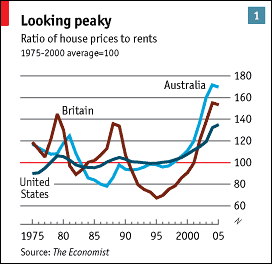
As we can see from the graph where a ratio of house prices to rents (P/R), which is equivalent to equity P/E ratio, the ratio was 100 in between 1975 - 2000. But the trend moved to north exponentially after 2000 when the Dot com bubble burst, this trend more prevail in Australia and Britain. Australia registered a ratio around 170, Britain 155 and US 135 in 2004. What is it means? The ratio of 170 means the price of real estate in Australia in 2004 is either 70% higher if compare to the average price for the period of 1975 - 2000 or the rental is 70% lower for the mentioned period. If you deduct all the related expenses for real estate such as management fee, broker fee, insurance charge and so forth, the ratio could be higher.

While people could argue that we could not compare real estate investment with equities because real estate is "REAL", it is not a paper value. True, real estate is "Real" in physical but the illusion of control could harm the judgment of the investors. For every investment decision made, we could not run from the reality of the rate of return, no matter it is in equities, bond, real estate, commodities market...etc.

Any indication for you?